
AIDRA: putting AI ship-detection on a satellite-sized computer
14 May 2026TL;DR
Earth-observation satellites take more pictures than they can send home. Most of those pictures are empty ocean. AIDRA is a SatCen project asking one question: can we run a useful AI ship-detector on the kind of tiny computer that fits on a satellite, instead of waiting to downlink the data and process it on the ground? What follows is my own small feasibility study around that same question.
The honest short answer, based on what I measured:
- Yes, but it shrinks. A standard YOLOv8 + CFAR vessel detector quantised to INT8 drops from 49.6 MB to 25.1 MB, runs ~35% faster, and keeps detection confidence virtually identical (53.6% vs 53.9%).
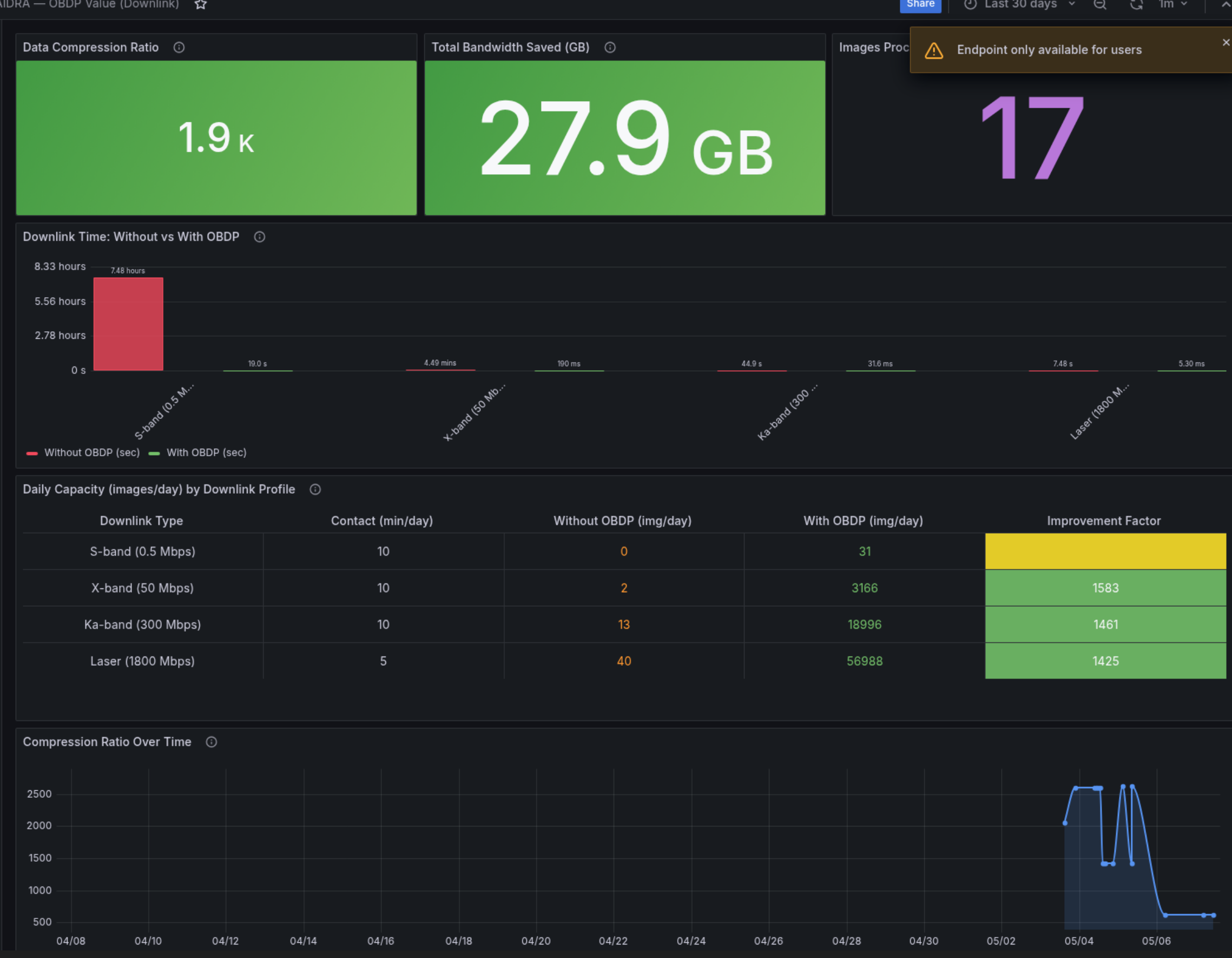
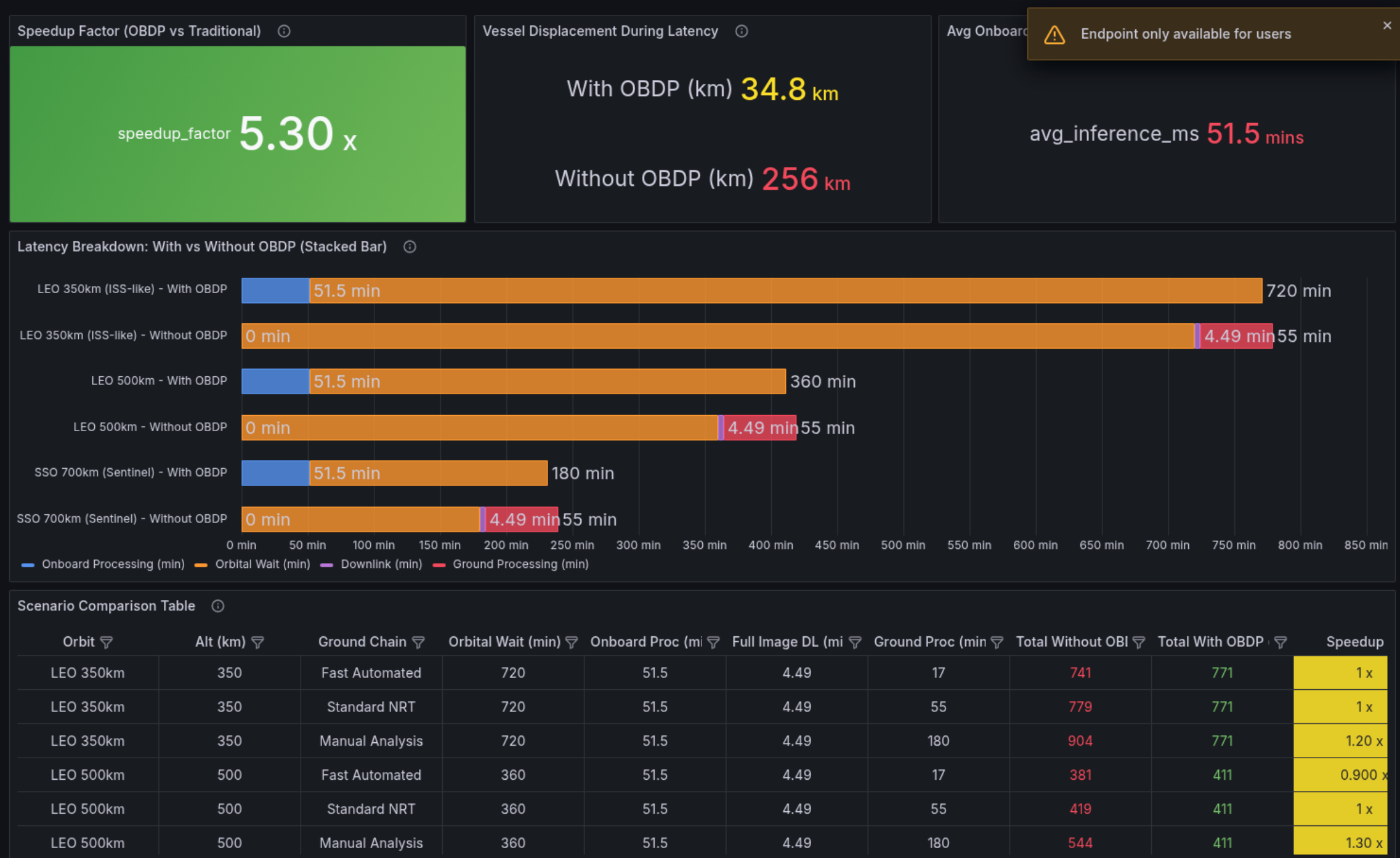
- The payoff is huge if you can afford the squeeze. On-board processing turns a Sentinel-1-style scene from a 27.9 GB downlink into a few hundred contact reports — a ~1,900× compression ratio, and the end-to-end “sensor → operator” latency drops by 5.3×.
- The hard part isn’t the model. It’s the paper trail. EU procurement (and the AI Act) wants every detection to be reproducible, hash-traceable, and explainable. That’s the part I spent most of my time on.
Everything below is live and auditable in a public Grafana at aidra.uliber.com, and the code is on GitHub.
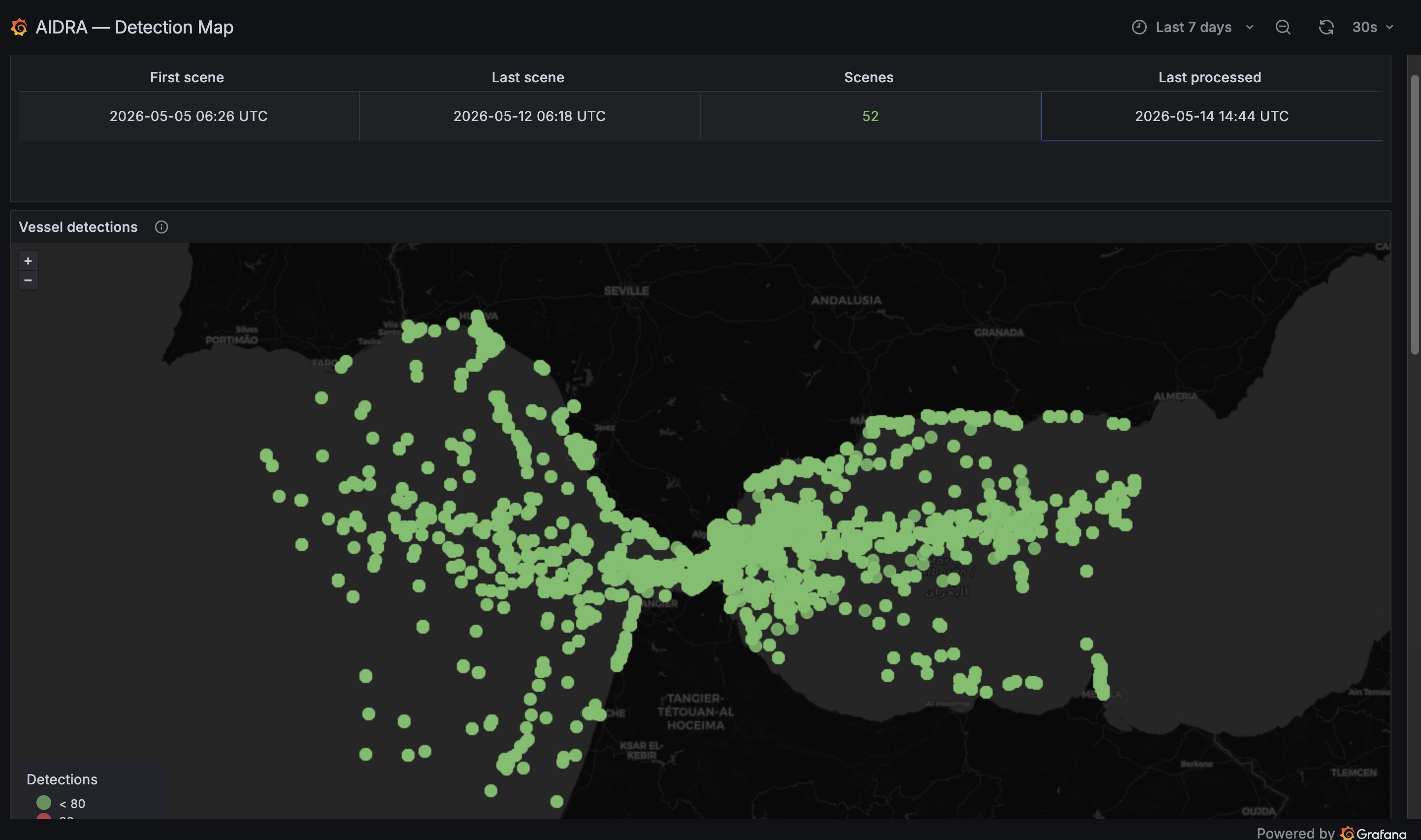
Every green dot is a vessel AIDRA flagged on a Sentinel-1 SAR scene. Strait of Gibraltar, several weeks of acquisitions. This is what the question “can the satellite see ships?” looks like when you say yes.
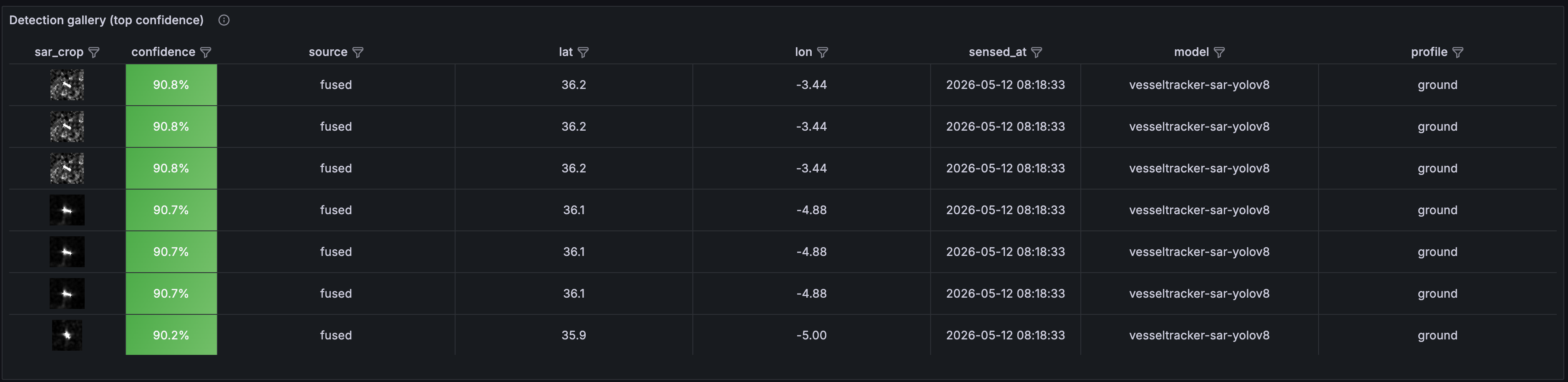
A single vessel detection, as seen by the YOLOv8 model on SAR imagery. The ‘detection’ is a set of coordinates and a confidence score tied to a specific SAR chip.
Why this project exists
In early 2026 the EU Satellite Centre (SatCen) in Madrid published a tender — SATCEN/2026/OP/0003 — asking for a feasibility study on running AI directly on-board Earth-observation satellites. The use case they care about is maritime surveillance: spotting vessels in SAR (radar) imagery without having to wait for the satellite to dump the full scene to a ground station.
I’m not bidding for that tender. But the question was genuinely interesting, and along the way I discovered something I had no idea about: Sentinel satellite imagery is open and free — anyone can pull it from the Copernicus Data Space portal with a free account. That alone was worth the rabbit hole.
Is on-board AI a real engineering option in 2026, or still science-fiction with a marketing budget?
AIDRA — AI-enabled On-Board Data Processing Assessment — is the actual SatCen project. The tender is asking external teams to study whether this is viable. What follows is my own personal take on it: a small feasibility study against the same evaluation grid, with measured numbers and a paper trail anyone can re-run.
The premise: a “fake satellite” you can actually rent
The single biggest constraint of an on-board AI is compute: you have a few watts, a few CPU cores, and a couple of gigabytes of RAM. You cannot ssh into a GPU rack at 700 km altitude.
I needed a way to simulate that without launching anything. The trick:
- The whole AIDRA pipeline runs on a single Oracle Cloud ARM VM — 4 Ampere Altra cores, 24 GB RAM, EU data residency.
- That box plays the role of “ground reference.”
- On top of it I define five constraint profiles —
ground,sat-mid,sat-low,sat-strict,sat-extreme— that throttle the same model down to spacecraft-class budgets (down to 0.25 OCPU / 512 MB RAM in the most aggressive one). - The same Sentinel-1 scene runs through all five. You can see exactly where the pipeline starts to break.
That last sentence is the whole point of the study. Not “does it work in the lab,” but “at what point does it stop working, and how gracefully?”
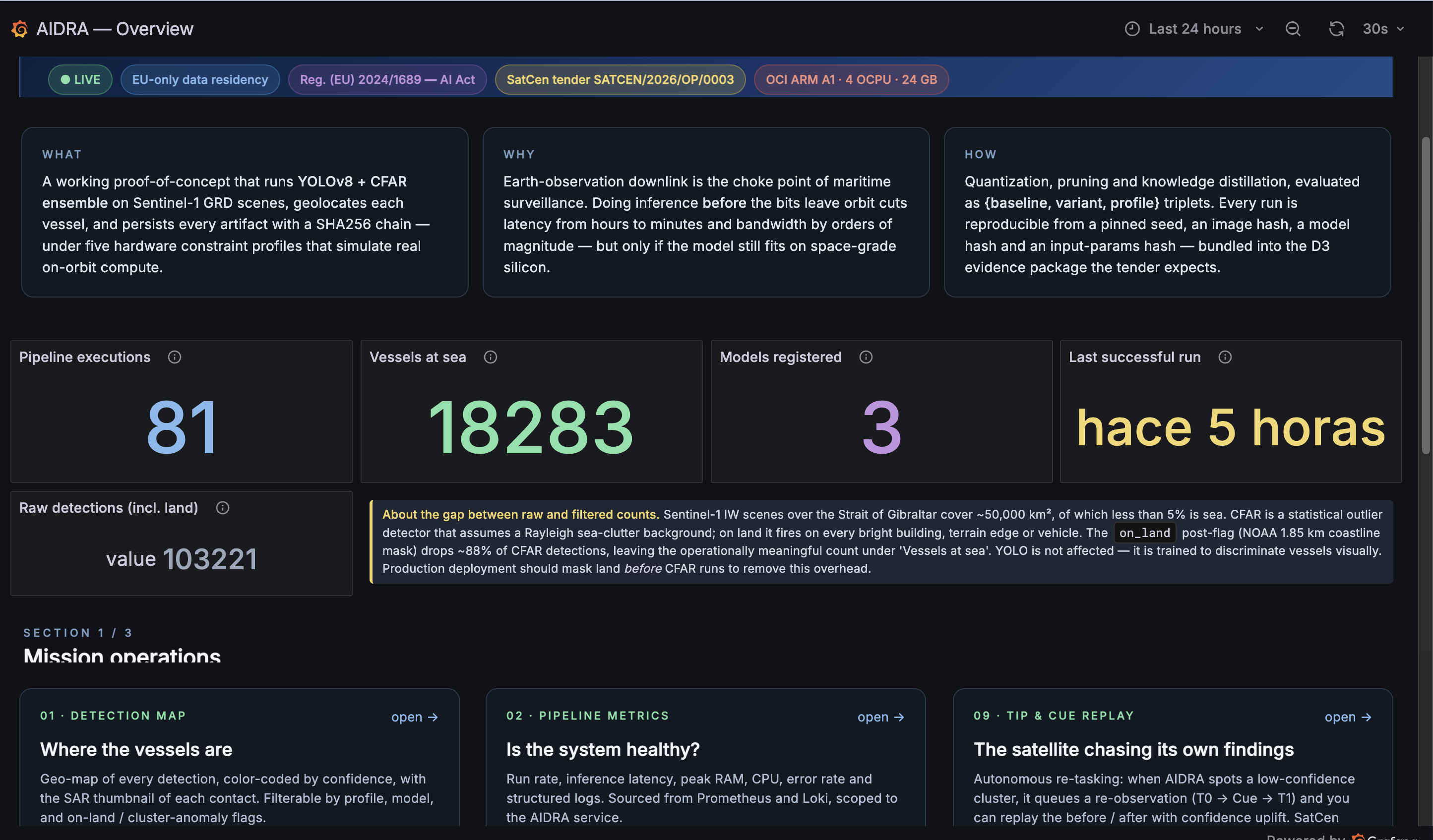
The home dashboard is the index.
What I actually measured
Three results stand out. None of them are surprising in isolation. The interesting thing is they’re all measured on the same hardware, with the same model family, end-to-end, and you can replay every single number from the public dashboards.
1. Compression: smaller, faster, same behaviour
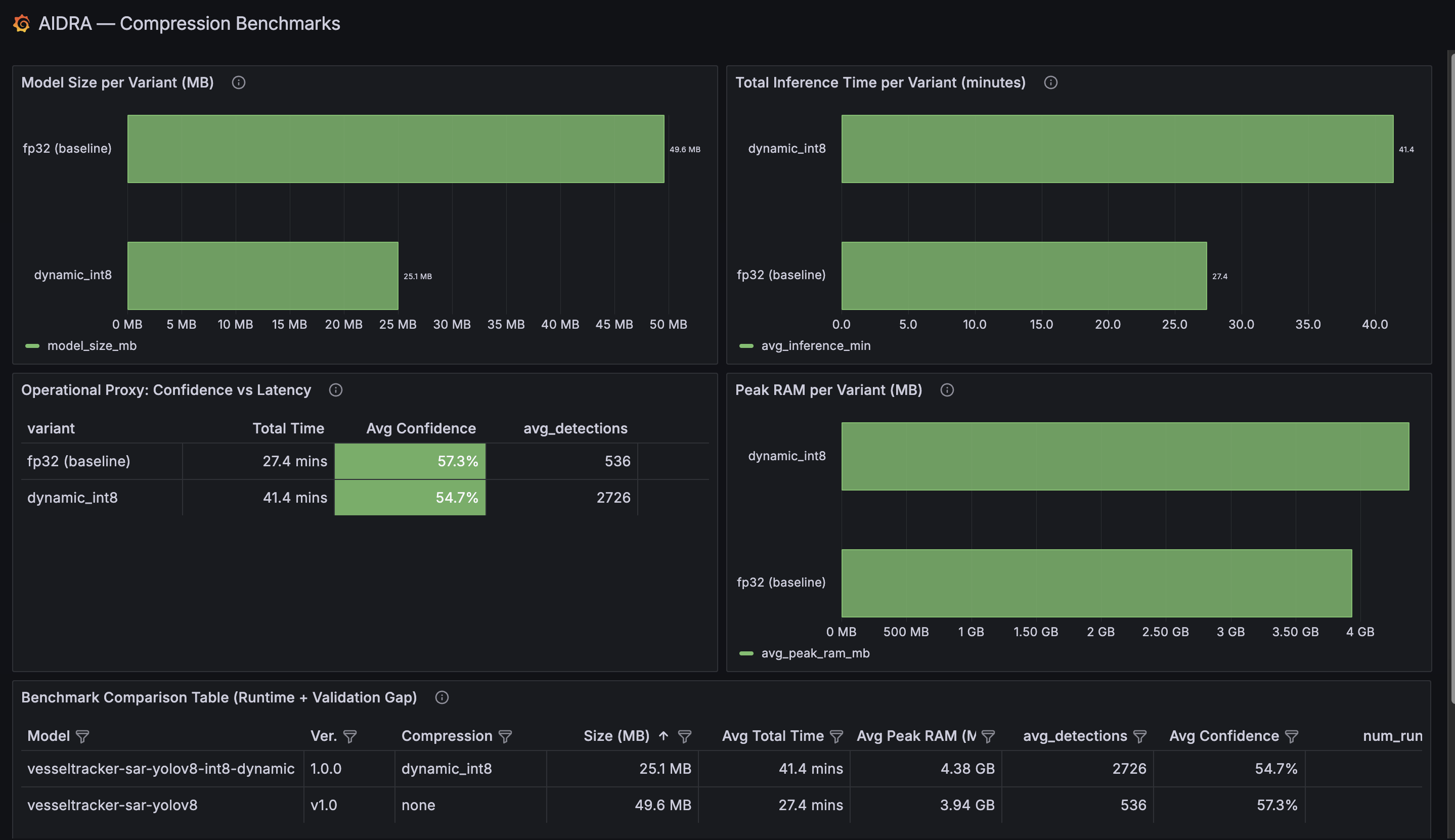
Quantising the YOLOv8 detector from FP32 to dynamic INT8 — a one-line PyTorch change — gives a clean trade-off:
| Variant | Model size | Total inference (50 scenes) | Avg detection score | Peak RAM |
|---|---|---|---|---|
| fp32 (baseline) | 49.6 MB | 52.7 min | 53.9% | 3.50 GB |
| dynamic_int8 | 25.1 MB | 33.9 min | 53.6% | 4.35 GB |
Half the disk. ~35% less wall-clock time. The INT8 variant produces effectively the same detections as the FP32 baseline — the 0.3-point gap in average detection score is well within noise (this is the model’s own confidence in each box, not accuracy against labels). Peak RAM actually goes up a bit (PyTorch’s dynamic INT8 keeps some FP32 staging buffers), which is the kind of detail you only see once you measure on the real target.
2. The on-board processing payoff
The question is: what happens to the end-to-end latency if the satellite processes the scene on-board and only downlinks the contact list, vs the traditional “dump the raw scene, process on the ground” workflow?
| Downlink | Without OBDP | With OBDP | Speed-up |
|---|---|---|---|
| S-band (0.5 Mbps) | 0 useful images/day | 31 | — |
| X-band (50 Mbps) | 2 | 3,166 | 1,583× |
| Ka-band (300 Mbps) | 13 | 18,996 | 1,461× |
| Laser (1.8 Gbps) | 40 | 56,988 | 1,425× |
On a typical X-band link, a satellite that processes scenes on-board can deliver ~1,500× more useful daily output than one that just acts as a camera. The ratio looks extreme because we’re comparing a raster downlink (pixels) to a vector downlink (a contact list) — that’s apples-to-oranges by construction, but it’s exactly the proposition: emit contacts, not pixels, and the radio link stops being the bottleneck.
In the orbital scenarios I modelled (LEO ~500 km, X-band downlink, constrained ground-station coverage), the end-to-end “vessel passes overhead → operator sees the contact” latency drops by ~5×. Most of that win isn’t faster processing — it’s not waiting for the next ground-station pass to dump a multi-GB raw scene.
3. Honest limits
What didn’t work, or only barely worked:
sat-extreme(0.25 OCPU, 512 MB) is below the floor. The model loads, but the runtime thrashes on swap and the per-scene latency goes from minutes to hours. That’s the failure mode worth reporting — not a number to brag about.- Cluster anomaly flags fire more often at the swath edge than I’d like. The current preprocessing chain (orbit correction → σ⁰ calibration → speckle filter → terrain correction → edge swath filter) cleans most of it, but a non-trivial fraction of “detections” near the image border are still SAR artefacts, not boats. I keep them, tag them
cluster_anomaly, and exclude them from the headline metrics. - The detector is not validated against ground truth in this study. The ~54% I report is the model’s own confidence per detection, not precision/recall against labelled vessels. A real deployment would benchmark against xView3-SAR / HRSID labels and report Pd / FAR — the metrics SatCen actually cares about. This study measures whether the pipeline is viable, not whether this specific detector is production-ready.
I’m noting these because the point of a feasibility study is not to oversell.
The second half: the bits the evaluator actually cares about
If you’ve made it this far and you don’t work in EU procurement, you can stop here. The summary above is the story.
For everyone else: in this kind of tender, the technology is rarely the differentiator — the differentiator is whether your methodology is auditable. Three things turned out to matter much more than the model:
Traceability as a first-class citizen
Every artefact that touches the pipeline gets a SHA-256:
- the raw Sentinel-1 product hash,
- the model weights hash,
- the input-parameters hash (the serialised
Settings), - the output GeoJSON hash,
- the git commit SHA at run time.
These five hashes are written to an execution_log table in PostgreSQL before the run starts (state = pending), then updated when the run finishes. Crashed runs don’t disappear — they stay in the log as failed, fully reproducible. The whole thing is one of the boring backbone tests in the repo, and it’s what lets me say “here’s the evidence bundle” instead of “trust me.”
AI Act compliance, baked in
The EU AI Act (Reg. 2024/1689) requires, among other things, that high-risk AI systems carry a model card with their purpose, training data, known biases, and limitations. AIDRA enforces this at the orchestration layer: a model without a MODEL_CARD.md cannot be registered, and therefore cannot run in the pipeline. It’s a one-line check that turns “we should write documentation” into “the system refuses to start without it.”
Geospatial integration that a GEOINT analyst would recognise
Detections are persisted with native PostGIS geometry (EPSG:4326), with the SAR thumbnail of each contact attached, filterable by profile / model / on-land flag, and exportable in the kind of OGC-friendly format that ground-segment systems already speak. Nothing exotic. Just the bare minimum to fit into existing workflows rather than asking analysts to learn a new tool.
The pieces, briefly
For the curious — the actual stack:
- Language: Python 3.11 end-to-end. FastAPI for the API, PyTorch for the model, rasterio + GDAL for SAR I/O.
- Detector: YOLOv8 (textural features) + a classical CFAR detector (point reflectors), ensembled. SAR-specific because optical sensors are useless at night and under clouds.
- Datasets: xView3-SAR, HRSID, OpenSARShip. All open, all license-compatible.
- Database: PostgreSQL 16 + PostGIS 3.4.
- Observability: Prometheus + Grafana + Loki, with
run_idpropagated end-to-end through logs and metric labels. The dashboards in this post are read straight from production. - Hosting: OCI ARM (Ampere Altra). One small VM, no GPU, EU-only data residency.
What this study is not
It’s not a satellite. It’s not a product. It’s not a benchmark of state-of-the-art vessel detection (the SOTA mAP figures live in academic papers, not on a single ARM VM). It does not promise to solve maritime surveillance.
It’s a deliberately small, honest exercise in answering: given the real-world constraints of on-board hardware, EU data sovereignty, and AI Act compliance, what does a working ship-detection pipeline actually look like, and where does it crack?
Code on GitHub. Dashboards and the full evidence bundle live at the AIDRA Grafana. Inspired by SatCen tender SATCEN/2026/OP/0003; not affiliated with SatCen or the European Union.